On a ground loom, weaving the rhythm of the desert row by row
How people live here
Al Sadu weaving is transmitted by Bedouin women, who use ground looms and natural fibers to produce dense, durable textiles. Repeated geometric designs and bright bands serve domestic uses and cultural presentations while carrying individual weavers' experience. Communities in places including Saudi Arabia, Kuwait and Qatar share the craft, whose exchanges and transmission cannot be understood through national borders alone.
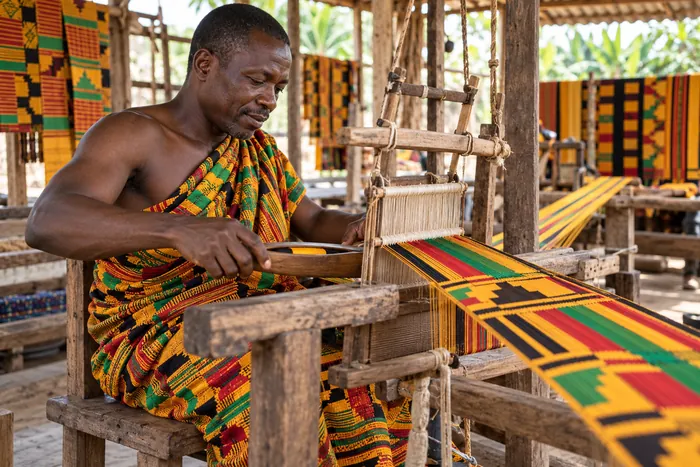
A loom close to the ground stretches the prepared warp into a long strip. The weaver passes the weft back and forth, and color bands and geometric shapes gradually emerge; the thickness, tension and tightness of the threads determine the structure and pattern of the finished piece. Uses once connected with dwelling and herding now also link to exhibitions, classes and new designs. Knowledge is often passed from experienced women to family members, and can also be exchanged in institutional courses. When looking at a finished textile, try to recall how many repeated movements it went through: the order of the pattern comes from long study, not from decoration added at random.
Take a closer look
A long loom close to the ground
Geometric stripes in red, black and other colors
Thread bundles being arranged and guided by the weaver
Look with respect
First ask before photographing the handwork process, and don't pull on the stretched warp threads; when buying, confirm the maker and materials, and don't call all geometric patterns by the same name.
These accounts describe particular places and communities. Consult current local information for dates, participation rules and contemporary forms.